Polyphagous Shot-Hole Borer Management
Polyphagous Shot-Hole Borer (PSHB) was detected in East Fremantle, Western Australia (WA) in August 2021. It’s unknown how and when the pest entered Australia.
While there have been no detections of PSHB outside the Perth metropolitan area, it is important for everyone to stay vigilant to help protect WA trees.
About the Polyphagous shot-hole borer
Polyphagous shot-hole borer (PSHB, Euwallacea fornicatus) is a small (approx. 2mm long) beetle native to Southeast Asia that tunnels into the trunks, stems and branches of trees and plants. This beetle is highly invasive and attacks a wide range of plant species, with over 500 documented globally to have been affected.
The department is responding to a detection of this invasive pest in the Perth metropolitan area and has implemented a Quarantine Area (QA). This restriction aims to prevent the spread of the pest by limiting the movement of wood and plant materials.
PSHB was detected in WA in August 2021. Since then, the department has been leading a nationally funded and coordinated biosecurity response. Allowing this pest to spread in WA could have a significant impact on our urban canopy and may pose a threat to our valuable agricultural industry.
Read more
Report sightings
You must report immediately if you:
- live in WA and have a box elder maple tree (on your property or street). The WA Government will check it for infestation by the borer.
- see signs of the polyphagous shot-hole borer in trees or plant material. Keep the material on your property.
If you suspect a pest or disease outbreak, report it. Even if you’re not sure.
Report to the WA Department of Primary Industries and Regional Development (DPIRD) through the MyPestGuide Reporter app or call the Exotic Plant Pest Hotline on 1800 084 881
For signs of exotic pests and diseases in imported goods, sea containers or parcels, call See. Secure. Report on 1800 798 636 or use our online form.
Legal duty to report
Euwallacea fornicatus (Eichhoff, 1868) is a declared pest in WA. It is a prohibited organism under section 12 of the Biosecurity and Agriculture Management Act 2007.
This means that any person who finds or suspects the presence of polyphagous shot-hole borer must report it to the department.
Follow the rules
Keep exotic dangerous pests and diseases out of Australia and follow domestic quarantine arrangements. Never ignore our strict biosecurity rules.
Import shipments may need to be treated and certified. Before you import, check our Biosecurity Import Conditions system (BICON).
Movement controls
A quarantine area remains in place across 30 local government areas in Perth, WA. This helps contain the spread of the borer. It also allows for surveillance activities to be undertaken.
The QA now encompasses two zones, Zone A and Zone B. The requirements for each zone are outlined on the WA DPIRD website.
You cannot move bark, potted plants, firewood, tree pruning's, logs, plant cuttings, mulch, timber, wood or wood chips out of the QA. These can act as a host and spread the beetle.
The polyphagous shot-hole borer does not affect grass. Lawn clippings can be disposed of as normal.
Check WA quarantine area requirements and map
How does PSHB spread?
PSHB is a tree-boring beetle that has a symbiotic relationship with a Fusarium fungus. It cultivates this fungus inside of plants as a food source for themselves and their larvae. In susceptible species, the fungus kills the plant by restricting or preventing the movement of water and nutrients. This causes symptoms such as Fusarium dieback that eventually leads to plant death. The beetle also causes structural damage by creating tunnels, known as galleries, throughout the plant.
Native to Southeast Asia, PSHB has spread to countries including Israel, the USA South Africa and Argentina, and is now in WA. It is possible PSHB ‘hitchhiked’ its way to Australia on untreated wooden articles and packaging materials. Subsequent spread can be aided by the movement of infested wood (such as pruned trees or unseasoned firewood).
Actions to minimise spread
Early Detection
- Monitor susceptible species including your local street and park trees for signs of PSHB damage and report any suspicious infestation signs to the department.
- Talk to your family, friends and neighbours to spread awareness to this invasive beetle
Firewood - buy it where you burn it
PSHB does not move far on its own but can travel long distances when people unknowingly intervene. Firewood can catalyse and provide a great mechanism for the distribution of PSHB without you knowing.
- Don't move firewood long distances including when you go camping - buy it where you burn it.
- Don't burn wood from host trees, especially if it looks like it has borer damage. PSHB beetles disperse when infested wood is burnt.
Tips for keeping your trees healthy
- Use grass clippings or compost as much as possible in your garden as wood chips from non-reputable places can spread PSHB
- While pruning or gardening check your plants and branches for sign of PSHB
- Disinfect pruning tools. Any tools (including chainsaws and woodchippers) that come into contact with infected wood should be sanitised before using on uninfected trees
- Avoid moving plants or wood products too far from your local area inside the QA
- Don’t move plants, wood or green waste from a known PSHB infestation area
- Follow the current QA requirements
- Plant native species over exotic plants
- Don’t take it upon yourself to dispose of a possibly infested plant
- Contact the department regarding any questions or advice
More information
Download PSHB Spot it, Report it Flyer
Polyphagous shot-hole borer information - Department of Primary Industries and Regional Development
Current Outbreaks - Polyphagous shot-hole borer (Euwallacea fornicatus) - Outbreak (Animal, Plant Pests, and Diseases)
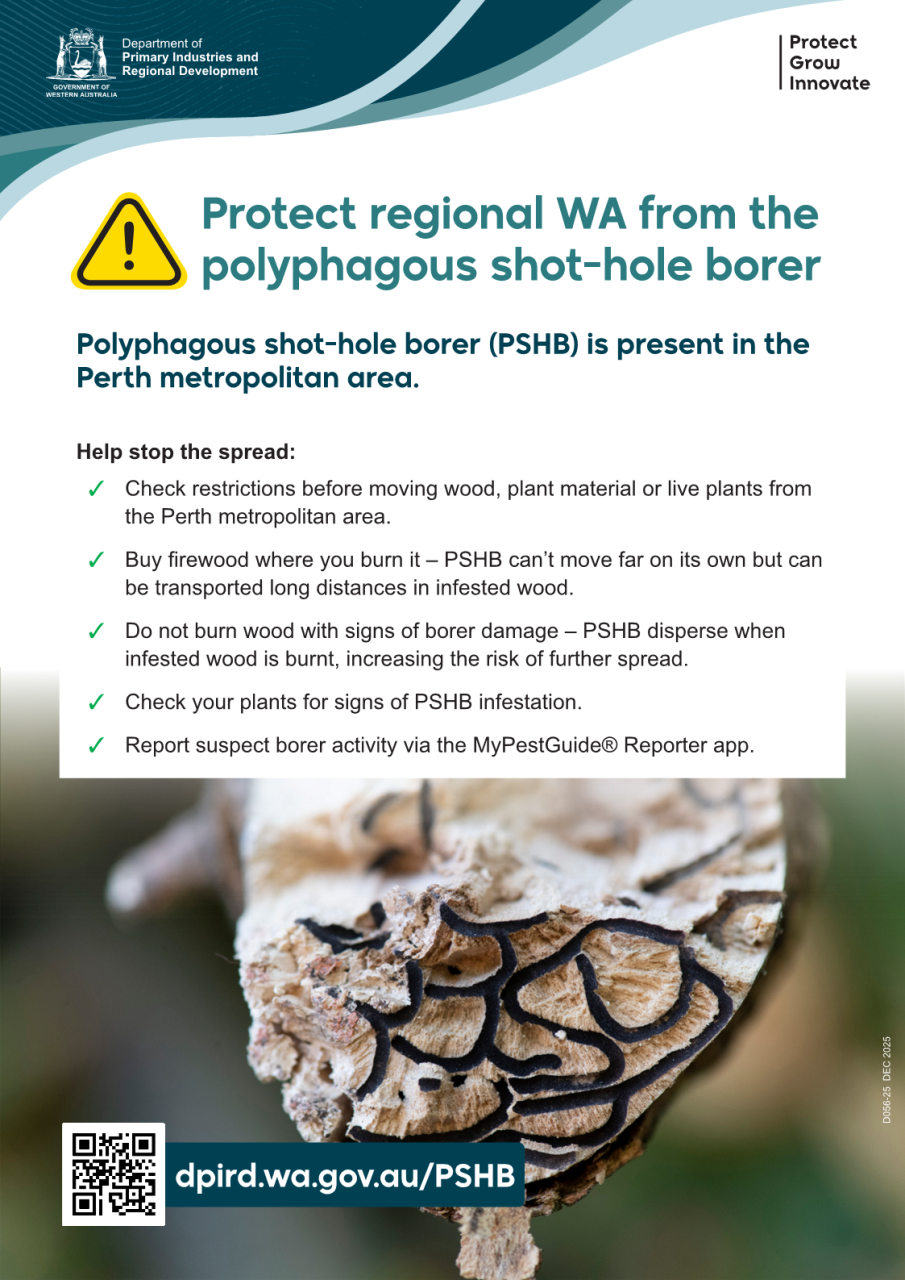
Protect regional WA from the PSHB