8 October - PROPOSED DEVELOPMENT ON FRENCH STREET, CORAL BAY – REQUEST FOR ENVIRONMENTAL CONSIDERATION AND COMMUNITY SUPPORT
1. Project context and safety
French Street is an existing public road reserve within the Coral Bay settlement. Although physically restricted to through traffic, parts of the reserve continue to be used for vehicle access and parking, while pedestrians and cyclists regularly use the area. The existing environment is unsealed and informal. The Shire’s independent Road Safety Audit and Coral Bay Transport Study identified safety considerations associated with vehicle, pedestrian and cyclist interactions.
The proposed works are principally intended to improve these existing conditions. The design includes a sealed surface, low-speed environment, pedestrian infrastructure, formalised parking,
lighting, drainage and other safety treatments. Sealing the existing surface is also expected to reduce dust and provide a more controlled road environment.
The proposed works do not, of themselves, constitute a final Council determination regarding the long-term operational status of French Street. That matter remains subject to the Shire’s applicable governance and decision-making processes.
2. Environmental requirements, vegetation and fauna
The Shire acknowledges its obligations under applicable Commonwealth and State environmental requirements, including the Environment Protection and Biodiversity Conservation Act 1999 and requirements applying to vegetation clearing.
The existing modified and currently used road reserve provides relevant context when considering the scale and nature of additional impacts arising from the proposed works; however, it does not remove the Shire’s environmental obligations.
Shire will document its assessment of the final works against applicable environmental requirements, including whether Commonwealth referral, a State clearing approval or other environmental approval is required before relevant works proceed.
The design identifies vegetation and established trees that may require removal. The extent of removal will be confirmed through final design, with opportunities to reduce removal considered
where practicable. The fauna observations identified in your correspondence will also be considered in determining whether additional investigation or management measures are required.
3. Groundwater, drainage and cumulative impacts
The project does not introduce new residential or tourism accommodation and does not itself generate ongoing wastewater or additional potable-water demand associated with such development.
The works will change the existing unsealed road surface and therefore alter stormwater behaviour. Drainage has consequently been incorporated into the engineering design. The final drainage solution and construction controls will be required to appropriately manage runoff and potential environmental impacts.
The Shire also acknowledges your broader concerns regarding cumulative development pressures within Coral Bay. French Street is; however, an existing road reserve and the proposed project is principally a road-safety improvement rather than a new residential, tourism or commercial development.
Broader cumulative pressures across Coral Bay are appropriately considered through relevant strategic planning and environmental processes. Any additional impacts directly attributable to the French Street works, including vegetation removal, drainage and construction disturbance, will nevertheless be considered and managed through the applicable project and statutory processes.
4. Information available
The Shire has undertaken detailed engineering design, community consultation, an independent Road Safety Audit and the Coral Bay Transport Study. The Road Safety Audit and Transport Study formed part of material previously presented to Council and are available through the Shire’s published Council records.
The current project design has also been presented locally through the Shire’s community engagement and project updates. A copy is enclosed for your information.
The Shire has not identified separate ecological, fauna or groundwater studies undertaken specifically for the French Street project. This does not determine whether additional assessment is required.
Any further investigation, referral or approval identified through consideration of the final works will be completed before the relevant works proceed.
6 October - CD006 EXTERNAL GRANTS – PROCUREMENT AND GRANTS/REDS GRANT $115K FOR 4WD TOURISM BUS
1. Question asked:
- whether the $115,000 REDS grant has been formally accepted;
- if accepted, the authority under which it was accepted;
- whether Council considered its acceptance;
- whether it was accepted under Chief Executive Officer discretion; and
- what Shire funds or resources have been committed.
The Shire has not formally accepted the REDS grant.
The Shire Administration is working through the project details with the Gascoyne Development Commission.
It’ s acceptance will be dealt with in accordance with Policy CD006 and incorporated into the Shire’s budget at the appropriate time.
The grant does not require a Shire financial contribution. Other project partners are proposed to contribute to the project.
As the grant has not been accepted, there is presently no Council resolution or exercise of Chief Executive Officer discretion approving its acceptance.
2. Question asked:
- whether the Tourism Product Development and Incubator Program, acquisition of a 12-seat four-wheel-drive tour bus, or an equivalent project was considered to be identified within the Corporate Business Plan for the purposes of Policy CD006;
- if so, which provisions of the Corporate Business Plan were relied upon;
- whether the project and its associated capital and recurrent expenditure were identified within the Long-Term Financial Plan; and
- if so, which provisions of the Long-Term Financial Plan were relied upon.
The Chief Executive Officer authorised submission of the REDS grant application. A separate Council resolution authorising the application was not obtained; accordingly, there is no Council meeting date, report, item or resolution number for that decision.
Rationale for the application
The application was a proactive response to an external funding opportunity to advance established, Council-endorsed tourism and economic development priorities.
The Economic Development Strategy 2023–2028, adopted by Council on 22 August 2023 under Item 7.3.2 and published on the Shire’s website, identifies insufficient investment in tourism products as am constraint on growth. It supports expanding visitor experiences, improving business readiness and diversifying tourism offerings.
The Corporate Business Plan also directs the Shire to actively seek third-party funding to offset Shire costs and support tourism development that complements Carnarvon’s natural advantages.
The proposed Tourism Product Development and Incubator Program, including the acquisition of a 12-seat four-wheel-drive tour bus, was developed to give practical effect to these priorities. The application was therefore pursued for its anticipated strategic and community benefits, rather than simply because funding was available.
This approach is consistent with CD006’s direction to actively scan the external funding environment and its provision for the CEO and Executive Leadership Team to assess potential funding opportunities.
Financial contribution and Council consideration
The application included further external funding, a partnership with WAITOC and an operational funding contribution that can be absorbed within the Visitor Centre’s existing operational budget.
Council retains the opportunity to approve or decline acceptance of the grant. A report to Council will set out the grant conditions, committed contribution, delivery capacity and whole-of-life costs, including vehicle operation, maintenance and replacement, so that Council can make an informed decision.
3. Question asked:
- if the project was not identified within the Corporate Business Plan and Long-Term Financial Plan, whether Council authorised the Shire to apply for the funding;
- the date of the relevant Council meeting; and
- the relevant report, item and resolution number.
The Corporate Business Plan directs the Shire to actively seek third-party funding to offset Shire costs and support tourism development that complements Carnarvon’s natural advantages.
There was very little intended financial impact on the Shire, the economic, social and strategic benefits to the shire and local Industry we professionally considered and demonstrated a commitment that was consistent to the Corporate Business Plan, Long Term Financial Plan and the Community Strategic Plan.
4. Question asked:
- the total project and vehicle acquisition cost;
- any Shire cash or in-kind contribution;
- staffing and administrative resources required to deliver the program;
- estimated annual vehicle and program operating costs;
- registration, insurance, fuel, servicing, repair and storage costs;
- depreciation, asset renewal and eventual replacement;
- anticipated vehicle utilisation;
- projected income or cost recovery;
- procurement and feasibility requirements;
- grant audit and close-out costs; and
- whether the $115,000 grant fully funds the acquisition and establishment of the program.
In developing the application, the Shire considered the anticipated economic, social and strategic benefits of the program and its intended financial impact. The application identified an operational contribution that can be absorbed within the Visitor Centre’s existing operational budget.
A report addressing the matters prescribed by Policy CD006 will be prepared for Council’s consideration before any decision to accept the funding.
It will address total project and vehicle acquisition costs; Shire cash and in-kind contributions; staffing and administration; annual operating costs; depreciation, renewal and replacement; anticipated utilisation and cost recovery; procurement and feasibility requirements; and grant audit and close-out costs.
The report will also establish whether the proposed $115,000 grant is sufficient to fund vehicle acquisition and program establishment.
Any funding gap or ongoing costs will be identified, together with potential sources of further external funding and contributions from project partners. The report will distinguish confirmed funding from prospective contributions and identify any residual financial exposure for the Shire.
The operational contribution identified in the application can be accommodated within the existing budget. The program’s full ongoing and whole-of-life costs will be addressed in the report to inform Council’s decision on grant acceptance.
5. Question asked:
- who would own the vehicle;
- who would be responsible for operating and maintaining it;
- how access by Aboriginal and emerging tourism operators would be administered;
and
- whether the grant agreement would require the Shire to operate, maintain or fund
the vehicle or program for a specified period.
Ownership
The intended arrangement was for the Shire to trade in an existing bus and acquire an upgraded vehicle for shared use across existing Shire activities and the Tourism Product Development and Incubator Program. The Shire would own the vehicle. This would improve the capability of the existing fleet without increasing the number of vehicles.
Operation and maintenance
The Shire would remain responsible for operating and maintaining the replacement bus, as it is for the existing vehicle. The proposal was intended to use existing operational arrangements and budget capacity.
A user-pays model is proposed for tourism program use, with charges intended to recover attributable costs and limit additional costs to the Shire. The adequacy of those charges, including their contribution to maintenance and longer-term asset replacement, will be assessed in the business case presented to Council.
Access by tourism operators
Access for Aboriginal and emerging tourism operators would be administered through a transparent process, with opportunities advertised and clear eligibility, allocation and charging arrangements.
Appropriate governance arrangements would address fairness, equitable access, safety, insurance and responsibilities for vehicle use.
Grant Obligations
Any grant conditions requiring the Shire to retain, operate, maintain or fund the vehicle or program for a specified period will be identified and presented to Council before a decision to accept the funding.
6. Question asked:
- how Council would be involved in considering the risks, benefits and longer-term implications of the grant.
The application sought to advance Council’s established priority of strengthening tourism and developing new tourism products, supported by the Shire’s adopted strategic direction.
Should the application be successful, a report and business case will be presented to Council before any decision to accept the grant. Council will be asked to consider the project’s strategic and community benefits, delivery risks, grant conditions, ownership and operating arrangements, and immediate and longer-term financial and resource implications.
Council will then determine whether to accept or decline the funding. Any necessary budget amendments will be presented for approval through the appropriate process.
6 October - Shire Services, Finances and Community Projects
Question One: What are the costs involved with utilising the Spacetoco venue booking platform and is this a cost-efficient approach, seeing that the Shire staff still have to support the process anyway? i.e. with explanations and keys and checking payments.
The annual subscription cost for SpacetoCo is $1,980, equivalent to $165 per month. It is an industry recognised international platform operating across Australia, New Zealand and the UK and is a WALGA preferred supplier.
SpacetoCo is a full-service software package, marketplace platform and consultation service that aims to create process efficiencies and increase occupancy rates for local council and community centre venue hire. It provides a centralised booking and payment system, making it easier for community members to book Shire venues and reducing manual administration for staff.
A service fee of 16.5% also applies to each booking. That fee covers more than payment processing. It includes (but is not limited to):
- automated correspondence and reminders;
- access codes for applicable facilities;
- managing bonds and refunds; and
- collecting and following up required documents, such as public liability insurance and liquor licences.
Automating routine booking tasks is a positive improvement. It supports a more convenient and consistent service, while allowing staff to focus on helping venue users and managing our community facilities.
Staff still assist with venue enquiries, keys and access, and payment oversight where needed. These practical responsibilities complement the automated booking process and help ensure venues are accessible and ready for use.
Further correspondence was provided to you by the Shire’s Executive Manager, Lifestyle & Community, via email on 15 September 2026.
As the system has only recently been introduced, the Shire is continually working to improve how facility and booking information appears in SpacetoCo. Your feedback on these matters has been considered and forwarded to the relevant teams.
Question Two: What is the net cost of running the Art Hub compared to the net cost of running all the sports grounds?
Based on actual expenditure and income for 2025/26, the Community Art Hub’s net cost was $54,502.36, compared with $105,671.78 in directly identifiable expenditure for sporting grounds.
| 2025/26 actual figures |
Community Art Hub |
Sporting grounds |
| Directly attributable expenditure |
$75,333.88 |
$105,671.78 |
| Income identified in this comparison |
$20,831.52 |
Not identified |
| Net cost based on these figures |
$54,502.36 |
Cannot be confirmed from these figures |
This comparison does not include grant funding, so it does not provide a complete picture of the funding supporting these facilities. The Art Hub’s staffing, operations and resources are wholly grant funded. Grants, partnerships, sponsorship and community contributions also provide opportunities to reduce the Shire’s costs and extend the activities available to residents.
Building-related costs account for the largest share of the expenditure identified: $62,602.90 for the Art Hub’s lease and building maintenance, and $72,757.38 for maintenance of the Premier Oval Pavilion and Netball Change Rooms.
The sporting grounds figure excludes broader parks and gardens expenditure, depreciation, plant costs and other shared costs that cannot be separately attributed from the available accounts. It therefore does not represent the full cost of providing sporting grounds.
Both arts and sporting facilities support community participation, wellbeing and connection. The Shire seeks external funding and community partnerships wherever practical to improve these services and reduce the contribution required from ratepayers.
Question Three: What is the value of unpaid Shire rates that are in arrears of more than 12 months?
As at 22 September 2026, unpaid Shire rates outstanding for more than 12 months totalled $1,959,336.
This includes:
- $260,146 in pensioner deferred rates, which are subject to statutory deferment arrangements and are not pursued through the Shire’s normal debt recovery processes.
- $1,699,190 owed by other ratepayers, which is subject to the Shire’s debt recovery processes.
Question Four: What is the total borrowings (debt) of the Shire and what is the interest cost for this financial year?
The Shire’s 2026/27 Statutory Budget, adopted on 28 August 2026, records outstanding loans of $2,552,030 at 30 June 2026 with the Western Australian Treasury Corporation. It also provides for $1,250,000 in new borrowings to purchase replacement plant during 2026/27. The outstanding loan balance will change as new loans are drawn and existing loan principal is repaid.
Budgeted interest costs for 2026/27 total $138,940, including $34,688 for the proposed plant borrowings.
The budget also authorises a temporary overdraft facility of up to $5,000,000 to manage cash flow during capital project delivery. This allows suppliers to be paid while the Shire awaits grant payments following project milestones, acquittals or completion. The approved overdraft limit is not an amount already borrowed; it only becomes debt to the extent that the facility is used.
Question Five: Were the unpaid rates of the previous owners of the Carnarvon Central Shopping Centre paid?
To protect ratepayers’ financial information, the Shire does not publicly disclose details of individual rates arrears or payment history. This approach reflects the restrictions on access to information about another person’s debt under section 5.95(2) of the Local Government Act 1995. Accordingly, the Shire cannot provide the account-specific information requested.
Question Six: Will the mural funded by Water Corporation and the Gascoyne Arts Council be returned to Van Dongen Park as part of the development?
The return of the mural is not included in the current development.
The artwork was completed in 2004 and affixed to a Water Corporation building. Following demolition of that building, the mural was relocated to the airport.
Any future reinstatement would require assessment of the structural integrity of the work, including whether it could achieve the applicable cyclone rating.
This request has been noted and will be considered in future stages of the project.
Question Seven: What is the total expected cost of the Van Dongen Park development and breakdown of the funding by grants and Shire own source revenue?
The total expected cost of the Van Dongen Park development is approximately $4.2M - and includes design and technical investigations, playground construction, soft and hard landscaping including toilets and car parking.
The breakdown of funding (ex GST) is as follows:
- Lotterywest grant: $1,807,424
- rPPP grant: $2,098,820
- Shire contribution: $293,756
11 August - PROPOSED 2026/27 DIFFERENTIAL RATES
Question One: The $115,000 spent on a bus, given Carnarvon has a public bus system and a bus charter business, what is the intended use of this bus? Who approved it? When did this item get
addressed by council? Where does it appear in the minutes? And was there a significant conflict of interest by the chair of the GDC? As ratepayer what is the process for me to book this bus?
The Shire has not spent $115,000 on a bus. The project relates to a successful application for funding under the State Government's Regional Economic Development (REDS) Grant Program for the Carnarvon Tourism Product Development and Incubator Program.
While the grant has been announced, the funding agreement is yet to be executed, and the vehicle has not been purchased. The project has therefore been reflected within the proposed budget in accordance with Australian Accounting Standards and advice provided by the Shire's external financial advisers, MOORE Australia.
The proposed vehicle is intended to support the development of new tourism experiences in Carnarvon by enabling guided coastal, rangeland and cultural tours and by providing an incubator for emerging local tourism operators, including Aboriginal-owned tourism businesses.
The objective is to help develop new tourism products and build local industry capacity rather than provide a public transport service. The grant application was prepared in accordance with the Shire's
External Grants Policy and aligns with the Shire's Strategic Community Plan, Economic Development Strategy and Tourism objectives.
The inclusion of the project within the proposed budget does not represent a standalone Council decision to purchase a bus. Rather, it reflects the accounting requirement to recognise the announced grant during the budget preparation process. Any expenditure will remain subject to the execution of the funding agreement and the Shire's normal procurement and governance processes.
In relation to your question regarding a conflict of interest involving the Chair of the Gascoyne Development Commission, the Shire is not aware of any finding or determination that a conflict of interest existed. The governance of the Regional Economic Development Scheme, including the management of any declarations of interest by members of the Gascoyne Development Commission, is a matter for the Commission and the State Government, not the Shire.
Finally, as the program is not yet operational, there is currently no public booking process for the vehicle. Should the project proceed, the Shire will develop and publicly communicate the operational model, including governance arrangements, eligibility, booking processes, fees (if applicable), insurance requirements and how the program will interact with existing tourism and transport operators.
Question Two: The purchase of a 4x4 for the CEO, it was my understanding that vehicles would be leased by the SoC, when did council change the policy of leasing vehicles?, What date was it ordered, Who ordered it, where in the SoC minutes does it appear? and What meeting did councilors approve this?
The Shire has no policy in relation to the acquisition of assets (vehicles or otherwise) or whether they are leased and or purchased. Local Government generally benefits from purchase rather that leasing -
For long-life assets that will be used continuously in service delivery—particularly vehicles, plant and operational equipment—the Shire’s default position should be to purchase, preferably through an established State Government Common Use Arrangement or the WALGA Preferred Supplier Program.
- When the Shire purchases an asset:
- it owns the asset;
- it controls when the asset is replaced;
- it can continue using it beyond the initially forecast replacement date where condition and operating cost justify that decision;
- it can transfer reusable fit-outs and accessories; and
- it receives the proceeds when the asset is eventually disposed of.
Under a lease, the lessor generally retains the residual value or incorporates it into the lease pricing. The Shire may therefore fund the use of the asset for several years but have no sale proceeds or continuing asset at the end of the term.
For a regional local government operating high-kilometre vehicles, specialised plant and heavily fitted operational units, that residual value can be material.
A lower annual lease payment can look attractive in an annual budget, but it does not mean the asset costs less.
There is no income-tax incentive
Private businesses may consider leasing because lease payments can produce taxation consequences. That incentive does not generally exist for a local government. The Income Tax Assessment Act identifies municipal corporations and local governing bodies as income-tax-exempt entities.
The Shire therefore does not obtain the same income-tax deduction benefit that may influence a private-sector lease decision.
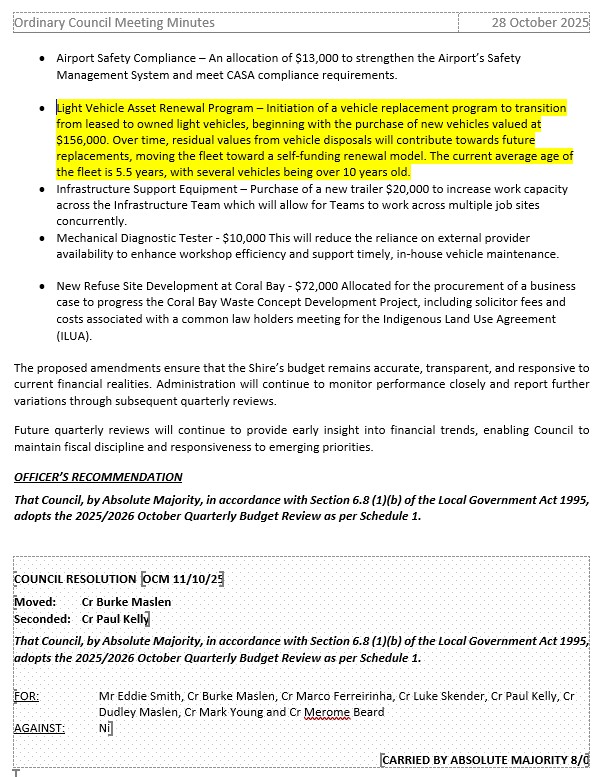
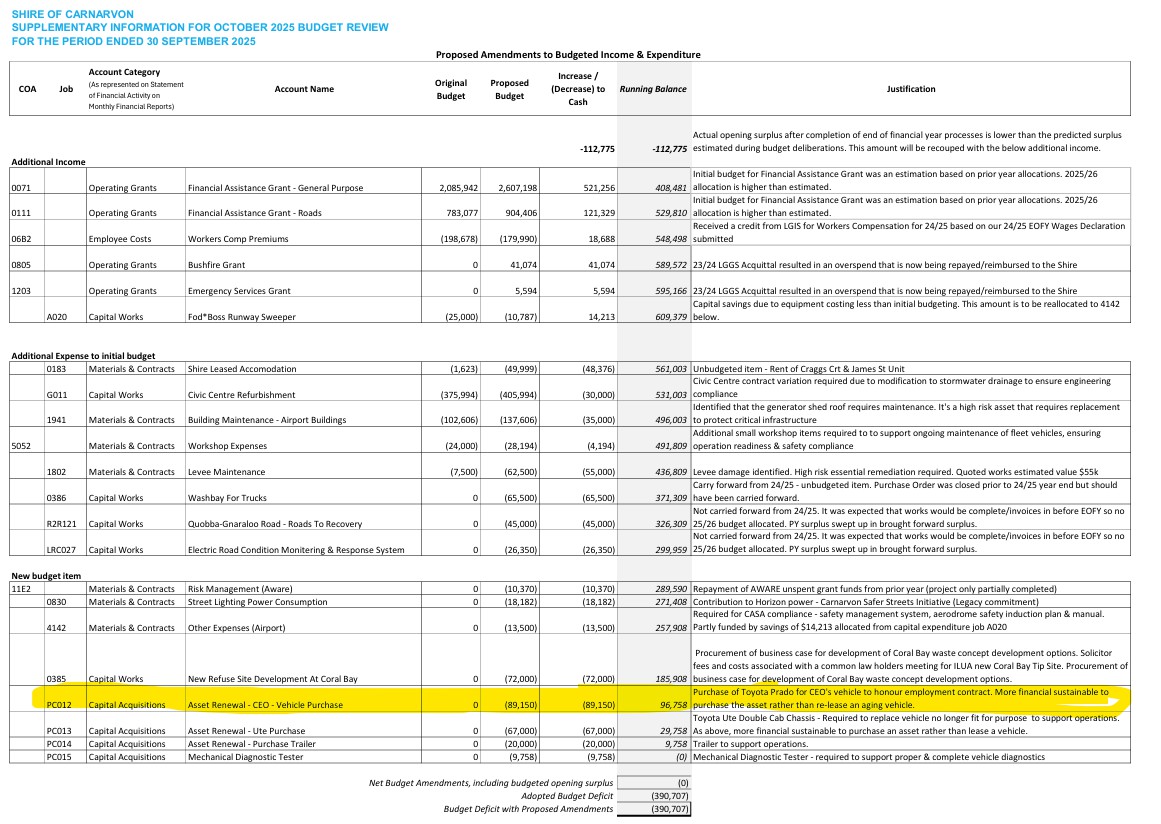
The Vehicle was ordered in consultation with the President and in accordance with the Shires Procurement Processes. The Vehicle is a tool-of-trade contractual entitlement of the CEO’s Employment Contract. Discussions were held with the President and staff excluding the CEO across August 2025 and September 2025. The President authorised the final decision to purchase over other considerations.
The Council authorisation through the Budget Process is included below -

Question Three: It is my opinion that there has been unfettered spending on staff, namely “the jobs for the boy’s mentality” this is a serious issue and warrants an investigation.
The Shire maintains an underlying workforce establishment of approximately 89 full-time equivalent positions. This number may fluctuate between financial years where additional positions are externally funded for specific programs, projects or service priorities.
For example, the Shire currently employs an additional 13 FTE through the Australian Government’s Remote Jobs and Economic Development Program. These positions, including associated employment on-costs, are fully funded through approximately $3.5 million in external funding over three years and do not form part of the Shire’s permanent base staffing establishment.
Employee expenditure is considered through the Council’s annual budget and ongoing financial reporting processes. The recruitment, appointment, promotion and management of employees are undertaken in accordance with the Local Government Act 1995, applicable employment requirements and the Shire’s adopted policies and procedures. Section 5.40 of the Act requires employees to be selected and promoted on the principles of merit and equity and expressly provides that employment powers must not be exercised on the basis of nepotism or patronage.
Matters concerning individual employees are confidential personnel matters and cannot appropriately be discussed or disclosed publicly.
Should you hold specific information or evidence suggesting that an appointment, expenditure decision or employment process was improper, you may lodge a written complaint through the Shire’s formal complaints process. The complaint should clearly identify the particular decision or conduct of concern, the relevant circumstances and dates, and any supporting information or evidence. A generalised, allegation, without particulars or supporting evidence, is not sufficient in itself to establish that wrongdoing has occurred or to support a formal investigation.
10 August - CORAL BAY RATES, SPECIFIED AREA RATE AND SHIRE SERVICE DELIVERY
Question One: How many ratepayers are there in Coral Bay?
There are 42 rateable assessments in Coral Bay, held across approximately 34 distinct ratepayer accounts.
The number of ratepayer accounts is lower than the number of assessments because several ratepayers hold more than one property or assessment within Coral Bay.
The review also identified six non-rateable assessments associated with State Government and Department of Biodiversity, Conservation and Attractions land holdings. These assessments do not pay general rates or the Coral Bay Specified Area Rate.
Question Two: What is the total value of rates collected in Coral Bay from developed and undeveloped land?
The figures below represent the amounts levied for the completed 2025/26 financial year, rather than cash receipts collected.
Determining the exact amount collected would require a separate reconciliation of payments received, rates arrears and outstanding balances.
For 2025/26, the verified amounts levied against Coral Bay assessments were:
- General rates – $603,536.28
- Coral Bay Tip Maintenance Specified Area Rate – $419,888.28
- Combined levy, excluding the Emergency Services Levy – $1,023,424.56
The rateable assessment base includes developed, vacant, commercial and tourism land. However, the rating data does not contain a consistently applied developed or undeveloped classification across all assessments. Undeveloped land if allocated as a rateable parcel and in the Coral Bay Development boundary will be rated as per the GRV category. If the land is undeveloped and not yet a rateable parcel as administered by Landgate it will not currently be rated.
The 8.5 per cent increase referred to in your correspondence relates to the 2026/27 rating year. The figures above relate to the completed 2025/26 financial year and were used because they could be verified against the final rating and expenditure records.
Question Three: How are Coral Bay rates spent?
Local governments do not record or manage each town or ward as a separate financial entity.
Regulation 7 of the Local Government (Financial Management) Regulations 1996 requires a local government to have regard to the needs of the district as a whole. It also prevents a local government from maintaining separate ward accounts or determining expenditure on the basis of revenue raised from a particular ward.
The Shire’s finances are therefore recorded through organisation-wide funds, service programs, general ledger accounts, jobs and asset records rather than through a separate Coral Bay profit-andloss account. General rates imposed under section 6.32 of the Local Government Act 1995 contribute towards the overall funding requirements of the Shire and support services and infrastructure across the district. General rates raised in Coral Bay are not quarantined for expenditure only within Coral Bay.
A Specified Area Rate is different. Section 6.37 of the Act allows a local government to impose a Specified Area Rate for a particular work, service or facility that benefits, is available to, or is contributed to by properties within a defined area. Money raised through the Specified Area Rate must be applied to that purpose.
The figures below are therefore the result of a targeted locality-based management review undertaken to identify Coral Bay-related activity from within the Shire’s broader financial records. They are not a separate statutory account for Coral Bay.
For 2025/26, the review identified:
- Direct operating expenditure – $479,767.79
- Approximate employee and vehicle allocation – $483,108.35
- Service-delivery cost before depreciation – $962,876.14
- Identifiable depreciation – $118,047.70
- Total operational and asset-use cost – $1,080,923.84
The employee and vehicle amount is a management estimate developed through targeted officer consultation where Coral Bay activity was not separately recorded in the financial system.
After recognising identifiable depreciation, Coral Bay’s operational and asset-use cost was approximately $57,499.28 higher than the combined general rates and Specified Area Rate levied.
The review also identified a further $175,634.68 in capital and project expenditure during 2025/26. This brought the gross cost and investment identified for Coral Bay during the year to $1,256,558.52.
This is a gross cost and investment comparison. Some capital and project expenditure is supported through external funding and should not be interpreted as having been funded entirely through Coral Bay general rates or the Specified Area Rate.
Key service areas included:
- waste services and waste-facility operations;
- public amenities and visitor infrastructure;
- Coral Bay Airstrip operations and maintenance;
- roads and infrastructure;
- Ranger services;
- community and tourism support;
- emergency management;
- employee, vehicle and corporate support; and
- elected member governance.
The review separately identified $297,198.34 in costs directly connected with the purpose of the Coral Bay Specified Area Rate. This included waste-facility operations, refuse and bin collection, environmental health oversight, identifiable waste depreciation and waste-related project expenditure.
The difference between the costs directly identified through the review and the Specified Area Rate levied should not be interpreted as an available surplus or as evidence that the rate was not used for its stated purpose. Not all executive oversight, contract management, new waste site planning, vehicle use and corporate support costs could be separately apportioned to the waste service.
Question Four: What works have been undertaken in Coral Bay over the previous five years?
The Shire does not maintain separate locality-based accounting records and has not prepared a transaction-by-transaction list of every historical Coral Bay expense.
The following is a high-level summary of completed physical works, design and investigation activity, strategic infrastructure planning and ongoing asset-management initiatives identified over the previous five years.
Coral Bay Shared Path to the Boat Ramp
Design for a proposed 1.35-kilometre shared path from the townsite to the boat ramp was completed in 2022 at a cost of approximately $26,960 excluding GST.
Construction was deferred by Council in 2023 after project estimates exceeded $900,000. The completed design remains available to support a future funding application.
Waste management and replacement-site planning
The Shire has continued operating the licensed Coral Bay Waste Facility and providing high-frequency waste, refuse and litter-bin collection services.
Work has also included Waste Concept Development investigations, surveys of the existing and proposed waste-facility sites, cyclone-related repairs and planning for a future replacement facility.
Coral Bay Airstrip
Major pavement reshaping and polymer stabilisation works were completed in 2023 to improve the binding and serviceability of the existing pavement material.
The Shire has also continued monthly safety inspections, maintenance, serviceability checks and assetmanagement activity.
Roads, streets and public areas
Activities have included French Street Black Spot design and geotechnical investigations, contractor works on Banksia Drive and Airstrip Road, street maintenance, signage, vegetation and debris management, parking and pathway activity.
Coral Bay Precinct Structure Plan
Work has included development of the Coral Bay Precinct Structure Plan, community and stakeholder consultation and liaison with State Government and environmental agencies, including the Department of Biodiversity, Conservation and Attractions.
Planning and Building Services
The Shire has undertaken extensive building and planning services in Coral Bay with the significant development and building renewal that has been undertaken privately – development of the RAC Resort and Service Works Accommodation, Bay View Waterfront Apartments, Monks Developments – Units and Caravan Park and other town planning requirements have required extensive building and planning management and expertise.
Public amenities and visitor infrastructure
The Shire has continued cleaning and maintaining public ablutions and the fish-cleaning facility, undertaking drainage and minor amenity works, providing additional peak-period servicing and maintaining visitor signage and related infrastructure.
In addition to these initiatives, the Shire continues to provide Ranger, airport, tourism, library, governance, waste and emergency management services within Coral Bay.
Question Five: Do all ratepayers pay the Specified Area Rate and what is the total amount raised?
The Coral Bay Tip Maintenance Specified Area Rate applies to all rateable assessments within the specified area, including:
- residential properties;
- vacant land;
- commercial properties; and
- tourism properties.
It does not apply to the six non-rateable State Government and Department of Biodiversity, Conservation and Attractions assessments.
The Specified Area Rate is valuation-based. It is not a flat charge of approximately $1,500 applied equally to every property, and the amount payable therefore varies between assessments.
For 2025/26, the verified amount levied through the Coral Bay Tip Maintenance Specified Area Rate was $419,888.28.
Question Six: Do local businesses contribute?
Yes, rateable commercial and tourism properties within Coral Bay contribute through their property assessments in the same manner as other rateable properties.
The assessment base includes caravan parks, resorts, shops, telecommunications facilities, worker accommodation and other commercial and tourism properties. These assessments contribute through general rates and the Coral Bay Specified Area Rate.
Where a business operates from leased premises, the relevant rates liability rests with the rated property owner, subject to any private arrangements between the owner and occupier.
Question Seven - Reported $15,000 annual charge
The Shire has not identified a statutory Shire charge of $15,000 per year applying to Coral Bay residents.
Without a copy of the relevant lease, licence, service agreement, invoice or other supporting document, the Shire cannot reliably determine what the reported amount relates to.
Should you provide the relevant supporting documentation, the Shire can review the matter further.
10 August - LARGE MOBILE MACHINERY AND AMP
Question One: “The AMP lists Plant and Equipment at approximately $2.024 million. What is the basis of this valuation and does it accurately reflect current condition and replacement requirements?”
The Asset Management Plan records the Plant and Vehicles asset class at a fair value of approximately $2.024 million as at the time the AMP was prepared.
This is a depreciated accounting value derived from the Shire’s asset register and recognised valuation methodologies. It takes into account matters including asset age, assessed useful life, replacement-cost inputs and accumulated depreciation.
The figure is appropriate for the accounting and strategic planning purpose for which it was prepared. However, it does not represent:
- the current cost of replacing the fleet with new assets;
- the mechanical condition of each asset;
- the remaining operational life of individual machines;
- the economic viability of undertaking further repairs; or
- the order in which assets should be replaced.
Similarly, any percentage shown in the AMP’s asset-class summary should not be interpreted as meaning that the same percentage of the fleet is in good mechanical condition or adequately funded for replacement.
Current management work estimates that the replacement value of the broader plant portfolio is approximately $10 million, which illustrates the significant difference between depreciated accounting value and contemporary replacement cost.
Individual replacement decisions are therefore made through asset-specific assessments. These consider:
- operating hours or kilometres;
- current mechanical and structural condition;
- maintenance and breakdown history;
- downtime and service interruptions;
- utilisation and operational need;
- workplace safety and compliance;
- availability of parts and regional technical support;
- replacement, refurbishment and hire alternatives; and
- whole-of-life cost and current market pricing.
The grader, street sweeper and other major items are currently being assessed through this more detailed process as part of the 2026/27 Plant Replacement Program.
Question Two: “The AMP states that inventory and valuation data are reliable. What evidence supports this assessment?”
Within the AMP, the word “Reliable” has a specific technical meaning. It is a data-confidence classification based on the methodology adopted from the International Infrastructure Management Manual.
In that context, reliable data is information supported by sound records, procedures, investigations and analysis, with an expected level of accuracy of approximately plus or minus 10 per cent for strategic planning purposes.
The classification relates to the quality of the Shire’s asset inventory and valuation information. It does not mean that every item of plant is mechanically reliable, in good condition or appropriately timed for replacement.
The assessment is supported by information including:
- the Shire’s asset register;
- acquisition and age records;
- financial valuation and depreciation records;
- fleet and operational information;
- inspection records;
- operating hours and kilometres;
- maintenance and repair histories; and
- other available asset records.
The current 2026/27 plant review has gone further by examining three years of maintenance records, together with condition, safety, compliance, operating-hour and service-continuity information. The maintenance review identified approximately $535,833 of expenditure across the principal assets being considered for replacement. Maintenance cost is not the only replacement test, but it is an important part of the evidence.
The AMP should therefore be understood as a strategic foundation that is continually tested and refined as better operational and condition information becomes available.
Question Three: “When will the assumptions within the AMP next be reviewed?”
There are two levels of review. First, AMP assumptions are tested on an ongoing basis through:
- annual budget preparation;
- updates to the asset register;
- maintenance and operating-data reviews;
- condition inspections;
- individual plant replacement assessments; and
- changes in market prices, service requirements and financial capacity.
The current review of the grader, street sweeper and other plant assets is an example of that ongoing validation process.
Second, a comprehensive review and realignment of the AMP and the Shire’s broader strategic planning framework is proposed for 2027 (When Council can be orientated and adequately informed). This will allow the newly elected Council to establish its strategic direction and align the Council Plan, Strategic Community Plan, Corporate Business Plan, Long-Term Financial Plan, Asset Management Plan and supporting renewal programs.
The scheduling of that comprehensive review does not mean that urgent asset decisions will be deferred. Existing plans continue to operate, and safety-critical maintenance, condition assessment, budget decisions and necessary plant replacement will continue during the Commissioner’s term.
Question Four: “When will the Shire be in a position to fund replacement of these assets and how will that funding be raised?”
Subject to final Budget adoption, procurement compliance, final quotations and finance confirmation, the Shire proposes to commence a significant program of plant renewal during 2026/27.
The latest reconciled estimate for the complete proposed program is approximately $1.605 million to $1.631 million, excluding GST. This is a proposed program ceiling rather than an obligation to spend the entire amount.
The program has been prioritised according to risk.
Critical First Priorities
The proposed critical tranche totals approximately $917,500 and includes:
- replacement of the workshop truck hoist;
- replacement of the PGRA1 motor grader; and
- replacement of the PTRU4 tipper and crane.
These assets are not being prioritised simply because they are old. The workshop hoist has been
removed from service, the grader is out of service, and the tipper and crane have significant
structural and compliance concerns.
PGRA1 Grader
The existing grader is a 2004 Caterpillar 12H with approximately 15,000 operating hours. It is out of service, has significant corrosion and requires major repairs. The current preferred new replacement is estimated at approximately $485,500 excluding GST, subject to final procurement and comparison with any properly documented second-hand alternative.
High Priorities
Street sweeper - For the street sweeper, the preferred pathway is currently to purchase and comprehensively refurbish the existing leased unit.
That option is estimated at approximately $204,632 to $230,552 excluding GST and is expected to extend its service life by approximately three to five years. A new sweeper has been quoted at approximately $485,174 excluding GST. Subject to structural, lease, warranty and refurbishmentscope checks, refurbishment could therefore preserve approximately $255,000 to $281,000 for other priority plant requirements.
Funding
The current draft funding envelope provides for a combination of approximately:
- $1.25 million in new borrowings; and
- $460,000 from reserves.
The final funding mix remains subject to Budget adoption, Finance confirmation, supplier delivery schedules, reserve requirements and cashflow management. It is the priority of Council to keep the borrowings to a minimum and any adjustments in the end of year position will be directed to the purchase of this plant. Borrowings should be directed principally toward long-life, service-critical plant whose benefits will extend over a number of years.
Reserve funds and available cash may be more appropriate for shorter-life or lower-value items. Any trade-in and disposal proceeds should be returned to the Plant Reserve unless otherwise determined through the Budget.
The proposed $1.6 million program will not replace the entire ageing fleet. It is a substantial and necessary first tranche. The Shire cannot undo many years of deferred renewal in one Budget, but it can—and must—begin addressing the assets presenting the highest safety, compliance and service delivery risks.
Question Five – “When will the AMP reach a level of maturity where it can reliably inform planning documents and budgets?”
The AMP already performs an important strategic informing role. It assists the Shire to identify asset pressures, service risks and future renewal requirements, and it informs the Strategic Community Plan, Corporate Business Plan, Long-Term Financial Plan and Annual Budget.
However, the AMP should not be represented as a perfect or stand-alone replacement program.
Strategic asset information must be supplemented by current asset-specific evidence, including:
- mechanical and structural condition;
- maintenance and failure history;
- operating hours and utilisation;
- safety and compliance risk;
- remaining component life;
- service criticality;
- market pricing; and
- whole-of-life cost.
The proposed comprehensive review in 2027 (which was planned for the 2026/27 FY, however governance changes at the Shire and the Emergency and Recovery responses have delayed this work), together with the recommended development of a ten-year Plant and Fleet Renewal Strategy before preparation of the 2027/28 Budget, will provide a clearer, risk-ranked and financially modelled pathway for managing the remaining renewal backlog.
However, it must be noted that the AMP is sufficiently reliable to support strategic decision making and long-term planning at a portfolio level. The Shire will continue to improve its condition information, renewal forecasting, lifecycle costing, data quality and financial modelling for individual asset decisions.