Cyclone Emergency Information
Cyclone season in the Gascoyne region typically runs from 1 November to 30 April, however cyclones can occur at any time.
Being prepared helps protect you, your family and your property. This page provides clear, essential information to help you get ready, stay safe and stay informed.
Emergency Information: 13 3337 SES Emergency Assistance: 132 500
In a Emergency
If your life or property is in immediate danger, call 000.
For emergency updates and warnings, always follow official sources:
Get Prepared
Don't wait until a cyclone is approaching. prepare early.
Make A Plan
- Discuss what you will with your household
- Know where you will shelter
- Plan how you will communicate if services are disrupted
- Identify support for elderly family members, children and pets
Prepare an Emergency Kit
Your kit should include:
- Secure loose outdoor items
- Trim overhanging branches
- Clear gutters and drains
- Check roof and fencing
- Protect windows if needed
Preparation Checklist
Before Cyclone Season
- Update emergency kit
- Review your household plan
- Check property maintenance
- Save emergency contact numbers
When a Cyclone Is Approaching
- Monitor official warnings
- Charge devices
- Secure outdoor items
- park vehicles safely
- Store documents safely
Staying Safe During a Cyclone
While a cyclone is impacting your area:
- Stay indoors at all times
- Keep away from windows and glass doors
- Shelter in the strongest part of your home
- Use battery radio or mobile device for updates
- Avoid using gas or fuel appliance indoor
- Do not go outside during the 'eye' of the storm
Only leave your shelter when authorities say it is safe.
DFES has kindly provided a check list for you. Click here to download the list
DFES Cyclone Emergency Kit Fact Sheet. Click here to download
The New Australian Warning System
2024 saw the launch of the Australian Warning System (AWS). Please read this information as it may save property and lives.

Call to Action - Advice
- Prepare now
- Stay informed
- Monitor conditions
- Stay informed/threat is reduced
- Avoid the area
- Return with caution
Call to Action - Watch and Act
- Prepare to leave/evacuate
- Leave/evacuate now (if you are not prepared)
- Prepare to take shelter
- Move/stay indoors
- Stay near shelter
- Walk two or more streets back
- Monitor conditions as they are changing
- Be aware of ember attack
- Move to higher ground (away from creeks/rivers/coast)
- Limit time outside (cyclone, heat, asthma)
- Avoid the area/avoid the flooded area
- Stay away from damaged buildings and other hazards
- Prepare for isolation
- Protect yourself against the impacts of extreme heat
- Do not enter flood water
- Not safe to return
- Prepare your property (cyclone/storm)
Call to Action - Emergency Warning
- Leave/evacuate (immediately, by am/pm/hazard timing)
- Seek/take shelter now
- Shelter indoors now
- Too late/dangerous to leave
Stay Informed
For accurate, up-to-date information, rely on:
Important Contacts
Emergency Services (Police / Fire / Ambulance): 000
State Emergency Service (SES): 13 25 00
DFES Information Line: 13 33 37
Main Roads WA: 138 138
Evacuation Centres and Shelters
During sever weather events, evacuation centres may be opened o support residents who are unable to safley remain in their homes.
Primary Evacuation Centre
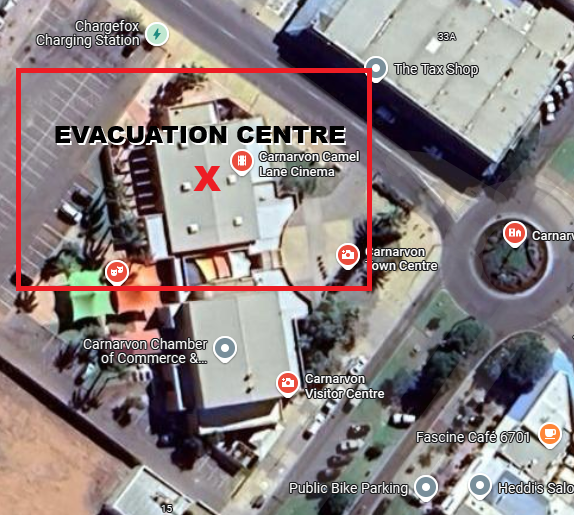
The Woolshed at the Carnarvon Civic Centre is normally used as the primary evacuation centre.
Please note: Thee Woolshed is currently under construction and may not be available.
Alternative Locations
If required, alternative evacuation centres may be established at:
- Local schools
- PCYC facilities
- Carnarvon Festival Ground
The Department of Communities operates evacuation centres in coordination with emergency services and the Shire.
They do not permit animals in the evacuation centre so ensure you seek adequate shelter for your fur babies and feathered friends. The Shire Ranger can house some dogs at the pound. They will be very safe. Contact the Shire on 9941 0000 for find out more.
Ensure you have your personal items and important documents such as drivers licence, passports, birth certificates etc with you, and some personal hygiene items and clothes for up to 3 days.
Spontaneous Volunteering
WHAT IS A SPONTANEOUS VOLUNTEER
Spontaneous volunteers are individuals or groups of people who have a strong desire to help. They are not affiliated with a volunteer involving organisation or formal emergency responders. Various terms including community volunteers, emergent volunteers and informal volunteers are often used interchangeably with the term spontaneous volunteer. These individuals perceive the immediacy of the situation and believe that their skills, resources, and experiences can help their community recover faster from the disaster. Based on their location and the type of activity they perform, spontaneous volunteers can be categorised into four types: local leaders, local helpers, external leaders and external helpers (Ahmad, 2024: www.volunteeringwa.org.au/assets/downloads/spontaneous-volunteer-engagement-report-vwa-july-2024.pdf)
PASTORAL / FARMER RESPONSE INCIDENT GUIDELINES
Are you having trouble determining whether you are a Spontaneous Volunteer or Bush Fire Brigade Volunteer?
Please use the decision-making tool listed below to assist in making that decision.
Pastoral/Farmer Response Incident Guidelines
